Description
Located at Roberts Bank in Delta, British Columbia, Westshore Terminals is Canada’s leading coal export terminal, and the busiest in North America. As part of the $800 million Potash Cargo Export Project, Westshore is expanding its operations to initially handle up to 4.5 million tonnes of potash per year from BHP’s Jansen Mine in Saskatchewan.
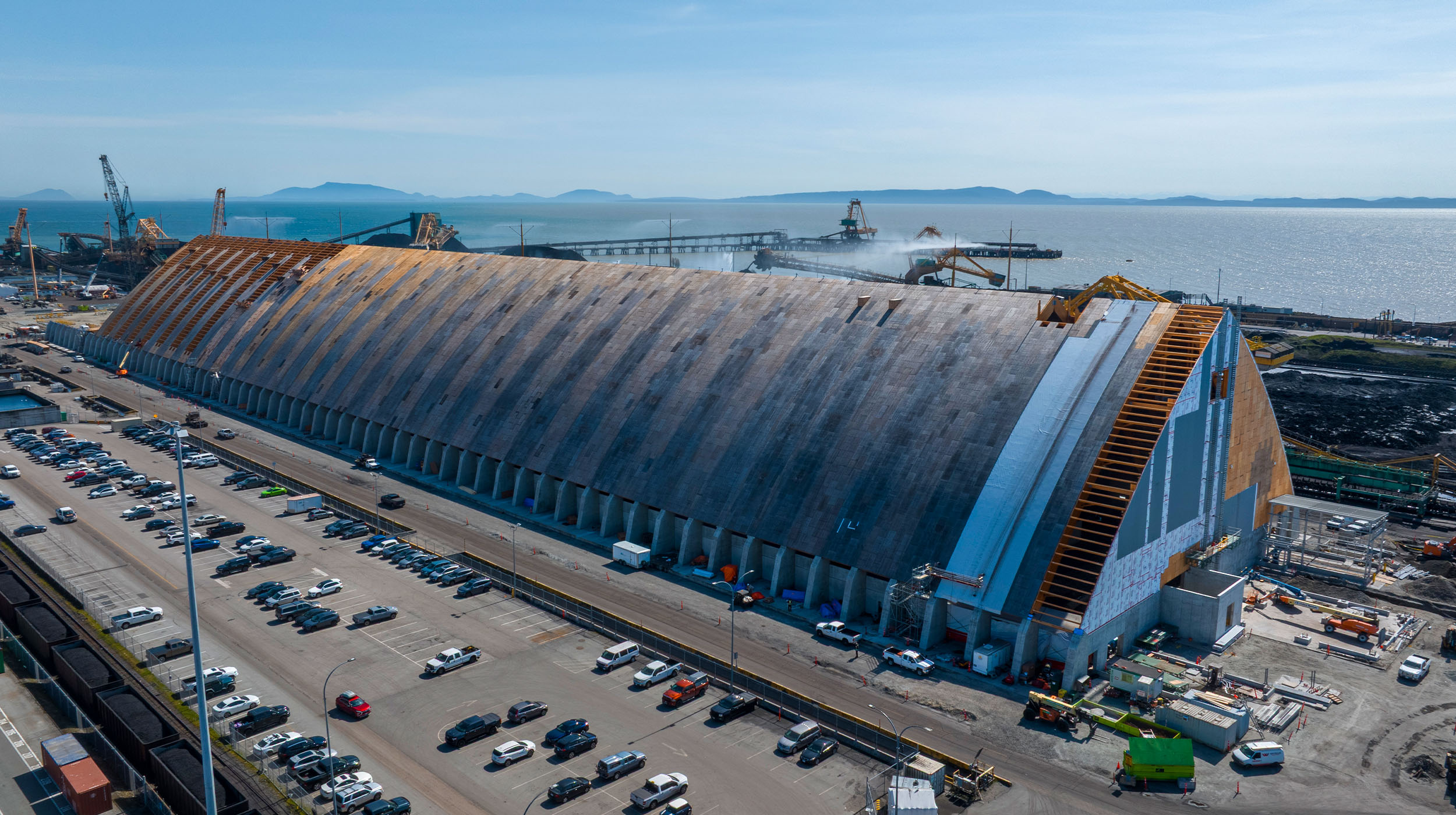
A key element of this expansion is the Potash Storage Building, an enclosed structure measuring approximately 400 metres in length, 70 metres in width, and 40 metres in height.
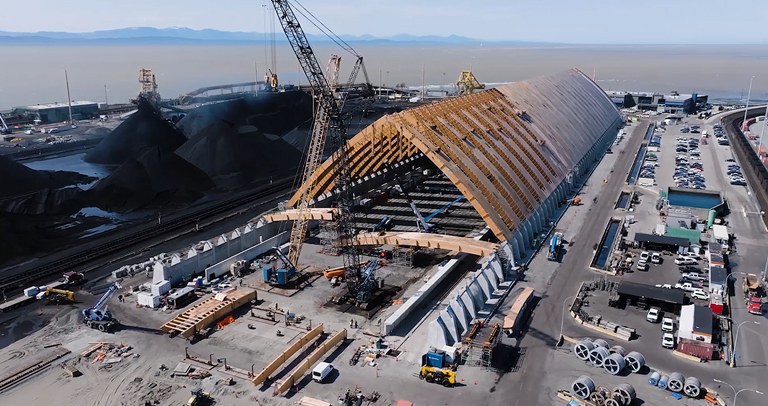
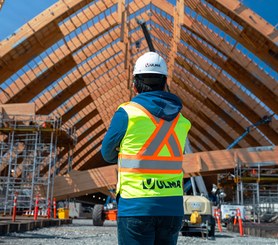
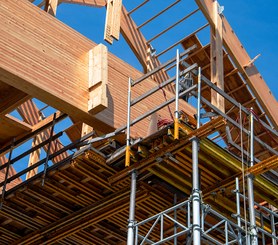
The building features an impressive arched roof made of glulam timber beams supported on concrete strip foundations, providing a fully enclosed and dust-controlled environment for potash storage and conveying operations.
ULMA Solution
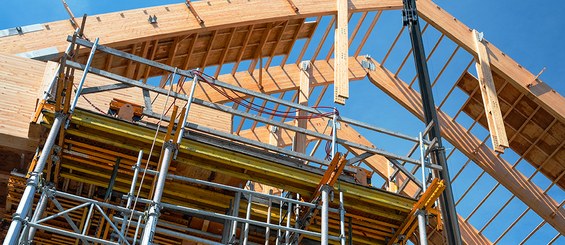
ULMA Construction Systems Canada was selected to provide the shoring and working platform solutions for the assembly of the arched timber structure, a critical component in the overall construction sequence.
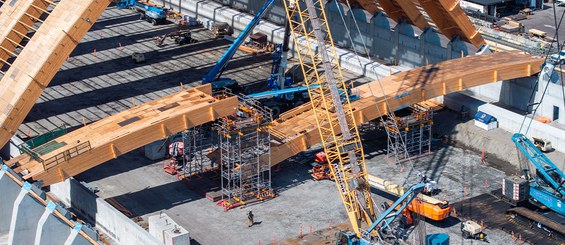
The project required the safe and efficient assembly of 68 glulam timber arch lines, each consisting of four 25-metre-long segments connected at splice locations before being lifted into their final position.
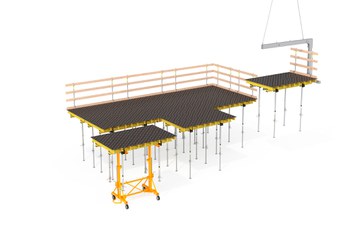
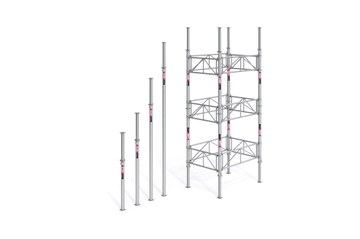
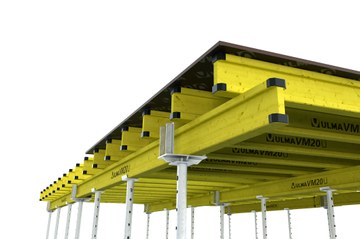
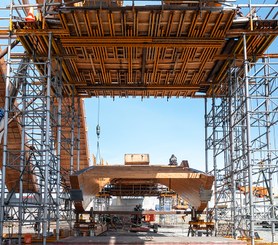
Given the variable elevations and the arched geometry of the roof, ULMA engineered custom ALUPROP shoring towers and VR Table working platforms, combining flexibility, precision, and safety.
- 68 lines of arch structure made from timber glulam beams needed to be assembled for the roof structure. Each line was designed using 4 pieces of 25-meters-long and 1.9-meters-high timber glulam beam.
- These beams had to be connected at splice locations on working platforms at different elevations from the ground before being lifted to their final locations.
- Due to the arched roof geometry, shoring towers needed to be stacked at different elevations — a challenge solved with ALUPROP towers in configurations of 2 m, 4.5 m, and 9 m, using only standard system components.
- To meet the tight project schedule, the shoring towers were designed to be relocated as complete units, eliminating the need for disassembly between gridlines.
- This approach enabled the contractor to assemble and lift one complete arch every five working days, improving overall construction efficiency.
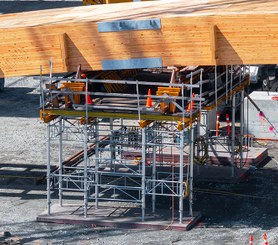
- Working platforms were required to carry the weight of the arched timber glulam beams temporarily while two 25-meter-long beams were connected at splice locations.
- The working area layout and height were optimized to provide safe access for workers and equipment handling the installation of the splice assembly for the 1.9m high beam.
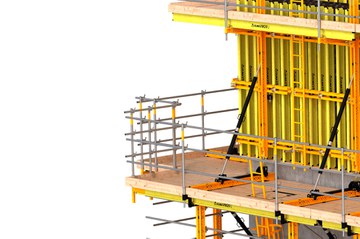
- Given the project’s exposed coastal location, the platforms were designed to resist high winds from the Pacific Ocean, with diagonal braces transferring the horizontal wind force to the ground.
- The hydraulic bottle jacks located on the working platforms were used for fine adjustments to align two glulam beams.
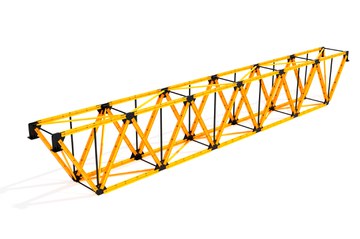
- MK-120 steel beams with various dimensions from 40 cm to 6 meters were used to meet all the requirements of the working area and the load capacity.
- All the elements of the working platform were connected to each other and to the shoring tower to have a single liftable unit without disassembly, for easy relocation and reduced downtime.
Project Features
- Stage 1: 400 m × 70 m × 40 m potash storage building.
- 68 glulam timber arches assembled using ULMA working platforms.
- Modular ALUPROP towers configured at multiple elevations.
- Single-lift assemblies minimized relocation time.
- Engineered to withstand strong coastal winds.
- Construction scheduled for 2025 under tight critical-path sequencing.